








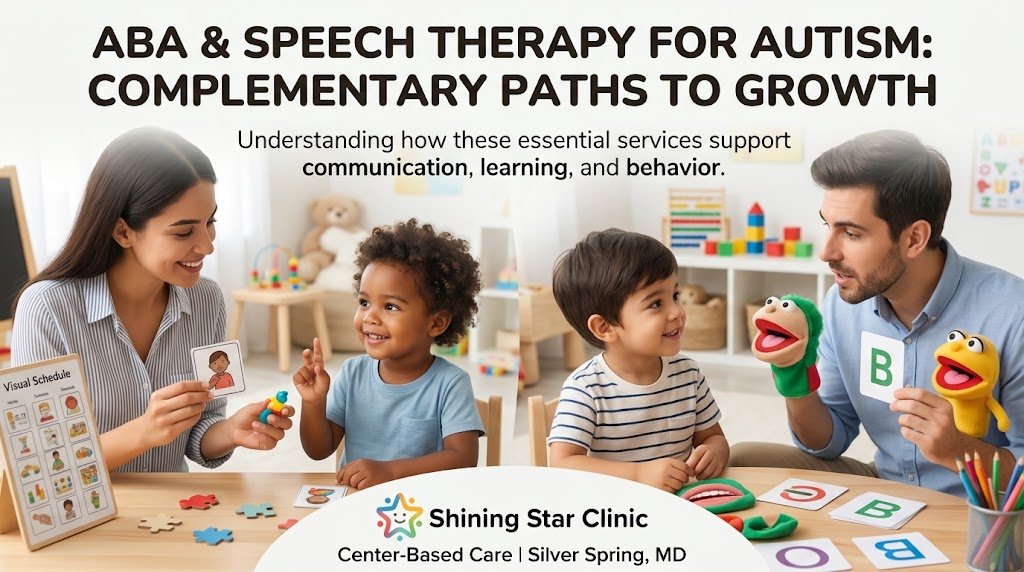
ABA therapy vs speech therapy is a common question for parents after an autism diagnosis.
The two services can address some related skills, particularly communication, but they use different clinical approaches and have different areas of practice.
A child may receive ABA therapy, speech therapy, or both based on their individual needs and recommendations from their treatment providers.
If your child already has an autism diagnosis and you are looking for center-based ABA therapy in Silver Spring, MD, Shining Star Clinic can help you start the ABA intake and insurance verification process.
Or call us at (301) 969-4214.
What Is ABA Therapy?
Applied Behavior Analysis, commonly called ABA therapy, focuses on understanding how behavior and learning occur and using individualized strategies to teach meaningful skills.
Depending on a child’s assessment and treatment plan, ABA goals may address:
- Functional communication
- Social interaction
- Play skills
- Following instructions
- Daily routines
- Independence
- Toileting and self-care skills
- Transitions and changes in routine
- Behaviors that interfere with learning or safety
Maryland Medicaid describes ABA as an evidence-based treatment for individuals with autism that includes techniques designed to increase useful behaviors, such as communication and social skills, and reduce behaviors that interfere with learning or may be harmful.
Source: Maryland Department of Health – ABA Program
At Shining Star Clinic, ABA treatment plans are developed and supervised by a BCBA. Behavior technicians provide direct treatment under appropriate supervision.
The Behavior Analyst Certification Board describes a BCBA as a graduate-level behavior analysis professional who can practice independently and supervise RBTs. An RBT works under close, ongoing supervision.
Source: Behavior Analyst Certification Board
What Is Speech Therapy?
Speech-language therapy is provided by a speech-language pathologist, or SLP.
Speech-language pathologists work with communication and swallowing. Depending on the child’s needs and the SLP’s area of practice, treatment can address areas such as:
- Speech sound production
- Language comprehension
- Expressing wants, needs, thoughts, and ideas
- Social communication
- Fluency
- Augmentative and alternative communication
- Feeding and swallowing
ASHA defines speech-language pathology as including communication and swallowing, with communication covering areas such as speech production, language, fluency, voice, cognition, and related skills.
Source: ASHA – Scope of Practice in Speech-Language Pathology
ABA Therapy vs. Speech Therapy: The Main Differences
| ABA Therapy | Speech Therapy |
|---|---|
| Primary provider: BCBA with behavior technicians working under supervision | Primary provider: Speech-language pathologist |
| Main approach: Behavior, learning, and functional skill development | Main approach: Communication, speech, language, feeding and swallowing within the SLP’s scope |
| Communication goals: May teach functional communication as part of a broader ABA plan | Provides specialized assessment and treatment of communication |
| Daily living skills: Often addressed when clinically appropriate | May be addressed when directly related to communication or feeding goals |
| Behavior goals: A central part of ABA treatment | Not the primary scope of speech-language therapy |
Neither service replaces the other. The right services depend on your child’s assessment, goals, and clinical needs.
Can My Child Receive ABA and Speech Therapy at the Same Time?
Yes. Some children receive ABA therapy and speech therapy during the same period of care when each service is clinically appropriate.
For example, an ABA program may work on functional requesting during everyday activities while a speech-language pathologist works on specific speech, language, or communication needs.
Coordination among providers can also help reduce conflicting goals.
ASHA includes collaboration with other professionals as part of speech-language pathology practice.
Source: ASHA – Scope of Practice
Can ABA Therapy Replace Speech Therapy?
ABA should not be presented as a substitute for speech-language pathology.
ABA programs can include communication goals, but an SLP has specialized education and clinical training in speech, language, communication, feeding, and swallowing.
If your child has speech or language concerns, ask the child’s pediatrician or treatment team if an SLP evaluation is appropriate.
Can Speech Therapy Replace ABA?
Speech therapy does not replace ABA when a child has broader behavioral or skill-development needs that require behavior-analytic treatment.
For example, a child’s ABA plan may address communication along with:
- Daily routines
- Transitions
- Social skills
- Independent functioning
- Play
- Learning readiness
- Behavior reduction goals
Your child’s treatment team should base recommendations on individual clinical needs rather than choosing one service simply because another service is already in place.
My Child Already Receives Speech Therapy. Can We Still Start ABA?
Yes, receiving speech therapy does not by itself prevent you from starting the ABA intake process.
If your child has an autism diagnosis and you are interested in ABA, you can submit your information to Shining Star Clinic while continuing other recommended services.
With parent or guardian permission, ABA providers can communicate with other members of the child’s treatment team when coordination is appropriate.
What Should I Do First?
If your main concern is speech, language, feeding, or swallowing, talk with your pediatrician about an evaluation by a qualified speech-language pathologist.
If your child has an autism diagnosis and you are looking for ABA therapy, you can contact an ABA provider directly to ask about intake requirements and insurance authorization.
If your child may need both services, you do not have to choose one before asking questions about the other.
Looking for ABA Therapy in Silver Spring, MD?
Shining Star Clinic provides center-based ABA therapy for children with autism at:
8121 Georgia Ave, Suite 450
Silver Spring, MD 20910
We serve families in Silver Spring and nearby Montgomery County communities, including Wheaton, Takoma Park, and Rockville.
If your child already has an autism diagnosis, you can start by completing our online intake form.
Have these items available if possible:
- Insurance information
- Insurance card
- Autism diagnostic report
- Your contact information
- Your child’s availability
Call Shining Star Clinic: (301) 969-4214
Our team can review your information, explain the ABA intake process, and tell you what additional documentation may be needed.